Where Grab Bars Go in a Home Bathroom
Where grab bars go beside a toilet, at a bathtub and in a shower in a Canadian home: heights, lengths, vertical, horizontal or angled, fold-down bars, the Ottawa research behind the layouts, and the mistakes to avoid.
Key Insight
Grab bar positions at a glance
| Location | Bar | Position | Usual length | Source of the figure |
|---|---|---|---|---|
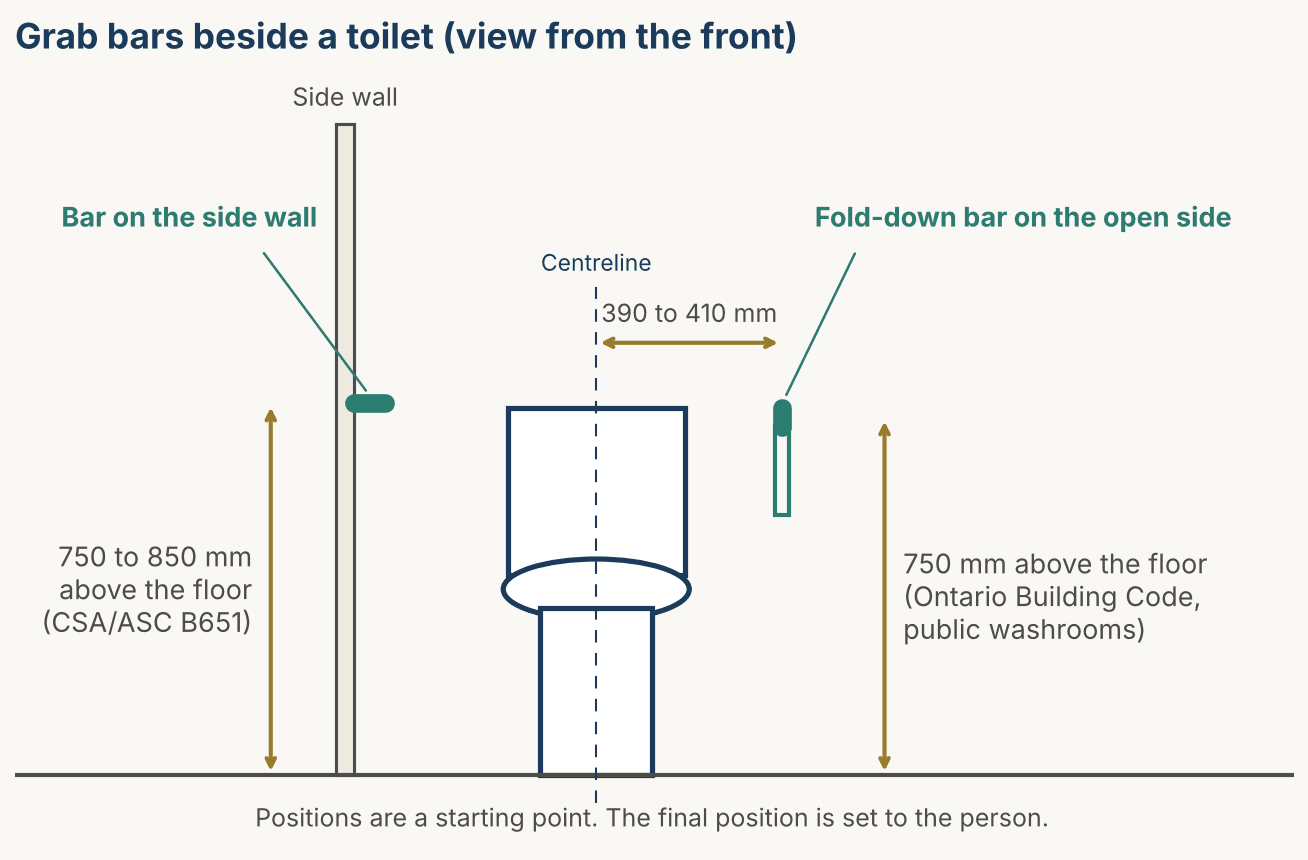
| Toilet, wall on one side | Horizontal bar on the side wall | 750 to 850 mm (29.5 to 33.5 in) above the floor | 600 to 750 mm (24 to 30 in) | CSA/ASC B651:23 |
| Toilet, no wall beside it | Fold-down bar | About 750 mm (29.5 in) above the floor, 390 to 410 mm (15 to 16 in) from the centre of the toilet | 750 mm (30 in) | Ontario Building Code, public washrooms |
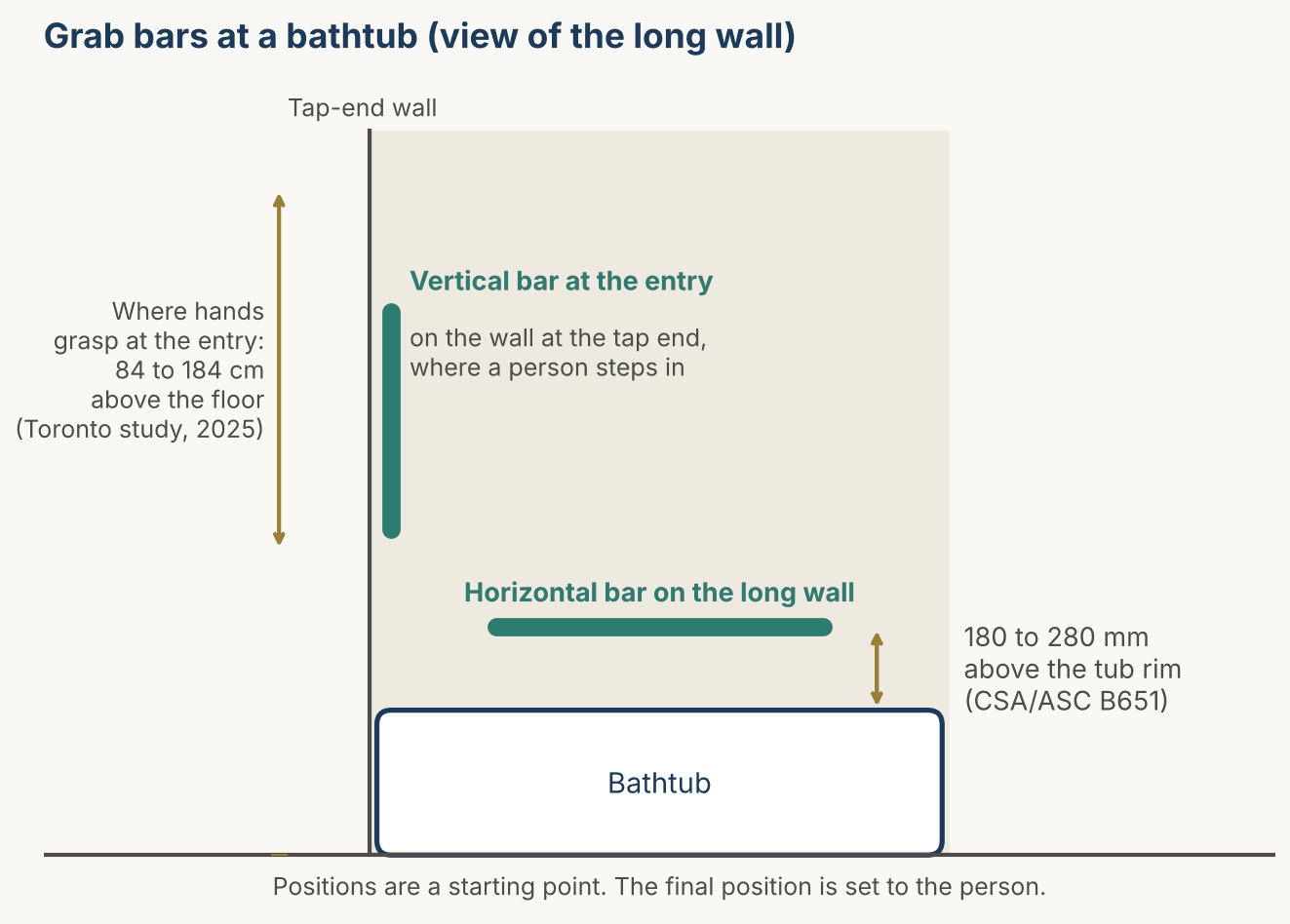
| Bathtub entry | Vertical bar | On the wall at the tap end or the entry side, where the hand reaches when stepping over the edge | 450 to 600 mm (18 to 24 in) | Ottawa and Toronto research |
| Bathtub long wall | Horizontal bar | 180 to 280 mm (7 to 11 in) above the tub rim | 600 to 1,200 mm (24 to 48 in) | CSA/ASC B651:23 |
| Shower entry | Vertical bar | Lower end 600 to 650 mm (24 to 26 in) above the floor | 450 to 1,000 mm (18 to 39 in) | Ontario Building Code, barrier-free showers |
| Shower, beside the seat or under the shower head | Horizontal bar | 750 to 870 mm (29.5 to 34 in) above the floor | 450 to 600 mm (18 to 24 in) | Ontario Building Code, barrier-free showers |
Why the numbers are a starting point at home
The figures come from two kinds of documents. CSA/ASC B651 is Canada's national standard for accessible design. The Ontario Building Code figures are written for barrier-free washrooms and showers in public buildings. Many heights quoted online come from American rules for public buildings. None of them was written for one person in their own bathroom.
At home, the right position depends on:
- ✓the person's height and reach
- ✓which arm and leg are stronger
- ✓whether they use a cane, a walker or a wheelchair
- ✓the task: stepping over a tub edge, lowering onto a bath seat, standing up from the toilet, or steadying while washing
- ✓the room: tub depth, where the taps are, how far the toilet sits from the wall, where the door swings
Each task puts the hand in a different place. A bar set for stepping in does little for standing up from a seat. That is why most bathrooms need two or three bars, and why each is marked with the person in the room before anything is drilled.
Beside the toilet
Sitting down and standing up from the toilet happens many times a day, so this is usually the first bar to install.
| Situation | What works | Notes |
|---|---|---|
| A wall within reach on one side | A horizontal bar on that wall, 750 to 850 mm above the floor | It should reach the front of the bowl or beyond. A bar that stops level with the tank is too far back to help |
| No wall within reach | A fold-down bar fixed to the wall behind the toilet | It folds up out of the way for cleaning, a wheelchair or a helper |
| Support wanted on both sides | A wall bar on one side and a fold-down bar on the other, or a fold-down bar on each side | Research supports a bar on each side (see below) |
| A person who pulls up to stand | A vertical bar ahead of the toilet, or an L-shaped bar | Vertical bars suit pulling. Horizontal bars suit pushing down |
Fold-down bars are the answer most often when the toilet stands away from a side wall. Ontario's rules for public washrooms place them 750 mm above the floor, 390 to 410 mm from the centre of the toilet, at least 750 mm long, and light enough to pull down with a force of no more than 22.2 newtons, about 2.3 kg (5 lb).
The bar behind the toilet that appears in public washrooms is rarely the useful one at home. Most people reach to the side or forward, not behind.
At the bathtub
Stepping over the tub edge is the hardest movement in most bathrooms. One foot is in the air, the floor is wet and the body is turning.
- 1A vertical bar at the entry. It goes on the wall at the tap end, or on the wall at the entry side, where the hand lands as the person steps over the edge. This is the bar research supports most strongly.
- 2A horizontal bar on the long wall. It sits 180 to 280 mm above the rim. It is for lowering into the tub or onto a bath seat and for rising again.
- 3A second bar where the person sits. With a bath seat or transfer bench, a bar within reach of the seated position helps with sitting and standing.
Two practical points:
- ✓Sliding glass doors. The frame of a tub or shower door is not a place to mount a bar or to hold on. The entry bar goes on the wall.
- ✓Tub and shower in one. A person standing to shower in a tub needs a bar at standing height as well as the low bar above the rim.
In a walk-in shower
- 1A vertical bar at the entry, on the side the person steps in.
- 2A horizontal bar beside the seat, for sitting down and standing up. In a shower with a fold-down seat, the bar goes on the wall beside or next to the seat, within reach when seated.
- 3A bar near the controls, so one hand is steady while the other adjusts the water.
How long should a grab bar be?
Long enough to cover every place the hand lands during the movement, and long enough to reach solid fastening at both ends.
- ✓Around tubs and showers, Still at Home most often installs bars 18 in (450 mm) and 24 in (600 mm) long.
- ✓Beside the toilet, a fold-down bar of about 750 mm (30 in), or a wall bar of 600 to 750 mm.
- ✓Public-building rules call for longer bars: 1,000 mm for the vertical shower bar and 1,200 mm for a tub bar in a care facility. Longer is useful where several people of different heights use the same bathroom.
Vertical, horizontal or angled?
| Direction | What it is for | Where |
|---|---|---|
| Vertical | Pulling, and steadying while stepping. The hand finds it at any height | Tub and shower entry, ahead of the toilet |
| Horizontal | Pushing down while sitting or rising, and steadying while standing | Tub long wall, beside a shower seat, beside the toilet |
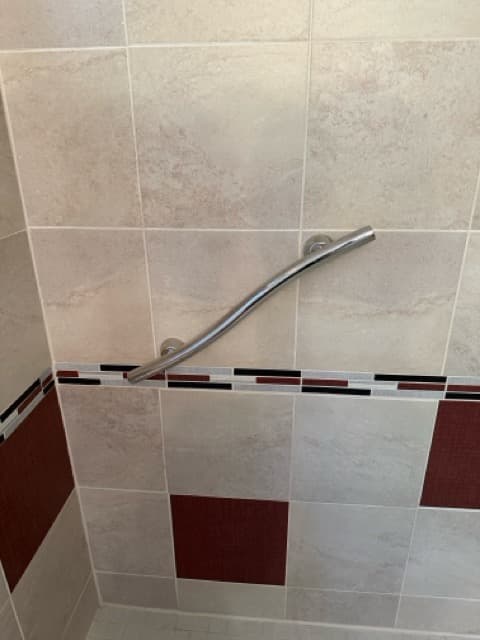
| Angled | Following the hand as the body moves from standing to sitting | Sometimes beside a toilet or at the seat end of a tub |
Opinions differ on angled bars. Some occupational therapists recommend a 45-degree bar because the hand can travel along it. Others avoid them in wet areas because a wet hand can slide down the slope. In a shower or tub, a vertical and a horizontal bar together do the same job without that risk. An angled bar is best left to an occupational therapist's recommendation.
Fitting the bars to the person
- ✓Height. A taller person grasps higher. In a 2025 Toronto study, the point where people grasped an entry bar changed with body height, and the authors suggest an entry bar covering roughly 84 to 184 cm (33 to 72 in) above the floor to suit most adults.
- ✓A stronger side. The bar goes where the stronger arm can reach it for the movement that matters most. For a toilet, that decides which side the bar is on.
- ✓A walker or wheelchair. Leave room to approach. A fold-down bar clears the space when it is not in use.
- ✓Two people sharing a bathroom. A longer vertical bar at the entry covers both heights.
Where there is weakness on one side, a recent operation or a hospital stay, a registered occupational therapist should set the positions.
What the research shows
Much of the research behind these layouts was done in Ottawa.
Bathtubs
- ✓Dr. Heidi Sveistrup of the University of Ottawa led a study in which 103 older adults tried five bathtub grab bar layouts and rated each for safety, comfort and ease of use. The layout based on the Ontario Building Code of the time was rated the least favourable. The layout people described as ideal had two bars: a vertical bar on the tap-end wall and a horizontal or angled bar on the long wall.
- ✓A follow-up study by the same group tested 80 adults getting in and out of a tub, with balance disturbed on some attempts. Older adults used the bars to regain their balance 59.4 per cent of the time, against 13.6 per cent for younger adults. Both groups favoured the vertical bar on the side wall for getting in and out. The authors called for building codes to be revised to include at least that bar.
- ✓In a Toronto laboratory study of 63 adults leaving a bathtub, people with a grab bar available recovered their balance more often than those without.
Toilets
- ✓A University of Ottawa study, co-authored by Dr. Sveistrup, compared seven arrangements beside a toilet with healthy older adults, older adults with a hip replacement and older adults who had had a stroke. Two vertical bars were preferred and produced the steadiest transfers. Two swing-away bars came second. A single horizontal bar and no bar at all were liked least.
- ✓A study with 130 residents of assisted living and nursing homes in the United States found that fold-down bars on both sides of the toilet worked better than the usual side-and-rear layout. The best positions were about 356 mm (14 in) from the centre of the toilet, 813 mm (32 in) above the floor, reaching at least 150 mm (6 in) past the front of the bowl.
The pattern is consistent: support on both sides at the toilet, a vertical bar where a person steps into the tub, and positions adjusted to the person.
Common mistakes
These are the errors occupational therapists and installers report most often.
- 1Bars placed where the studs are, not where the hand goes. The wall should be made to suit the position, with blocking or rated anchors.
- 2A toilet bar set too far back. It should reach past the front of the bowl.
- 3A bar at towel-bar height. Around 1,200 mm (48 in) is too high for pushing up from a seat.
- 4Only a rear bar at the toilet. It copies a public washroom and is rarely used.
- 5One bar expected to do every job. Entry and sitting need different bars.
- 6A towel bar used as a grab bar. It is not fastened to take a person's weight.
- 7Suction handles used for support. They can release without warning.
- 8A bar on the wrong side for the person's stronger arm.
- 9No one asked the person. The position was chosen without watching how they move.
Questions and answers
How many grab bars does a bathroom need? Most need two or three: one at the toilet, one at the tub or shower entry, and one where the person sits or stands to wash.
What height should a grab bar be beside a toilet? 750 to 850 mm (29.5 to 33.5 in) above the floor under the Canadian standard, adjusted to the person's seated reach.
Which side of the toilet should the bar go on? The side with a wall within reach, if there is one, and the side of the stronger arm. With no wall nearby, a fold-down bar goes on the side that suits the person.
Are fold-down grab bars sturdy? A fold-down bar made for the purpose and fastened to solid structure is designed to take a person's weight. What it is fastened to matters as much as the bar.
Should a grab bar be angled? In a tub or shower, a vertical and a horizontal bar are the safer pair. Beside a toilet, an angled bar can help some people. An occupational therapist can advise.
Can a grab bar double as a towel bar? Yes. A grab bar can hold a towel. A towel bar cannot hold a person.
Can grab bars go on tile, or on a fibreglass tub surround? On tile, usually yes, with the right fastening. A fibreglass or acrylic surround usually needs reinforcement first. See How a grab bar is installed properly.
Can grab bars be installed in a condo or rental? Yes, with permission. A condo corporation may have rules about work in units, and a landlord's consent is usually needed.
Are grab bars covered by a government program? They are an eligible expense under the federal Home Accessibility Tax Credit, worth 14 per cent of up to $20,000 in eligible expenses for 2026, for people who qualify. Ontario Renovates and the Home and Vehicle Modification Program also list them. See the grants guides.
Grab bar installation in Ottawa
Still at Home supplies and installs grab bars across Ottawa. Each bar is positioned with the person in the room, starting from the standards and research above, and the wall is checked at the same visit. Where there is weakness on one side, a recent hospital stay or a mobility aid, Still at Home works with a registered occupational therapist to set the positions.
Grab Bars, Supplied and Installed, starts at $329 plus HST for two bars in one visit. Expedited service with installation within 24 hours of approval is available. Details are on the grab bar installation page.
Sources
- 1CSA Group and Accessibility Standards Canada. CSA/ASC B651:23, Accessible design for the built environment. Clauses 6.2.6.4 and 6.5.6.2.1. https://www.csagroup.org/wp-content/uploads/2430328.pdf
- 2Ontario. Building Code, O. Reg. 163/24, Articles 3.8.3.8 and 3.8.3.13, as amended to October 1, 2026 (O. Reg. 325/26). https://www.ontario.ca/laws/regulation/240163
- 3Sveistrup H, Lockett D, Edwards N, Aminzadeh F. Evaluation of bath grab bar placement for older adults. Technology and Disability. 2006;18(2):45-55. https://journals.sagepub.com/doi/abs/10.3233/TAD-2006-18201
- 4Guitard P, Sveistrup H, Edwards N, Lockett D. Use of different bath grab bar configurations following a balance perturbation. Assistive Technology. 2011. doi:10.1080/10400435.2011.614674
- 5Kennedy MJ, Arcelus A, Guitard P, Goubran RA, Sveistrup H. Toilet grab-bar preference and center of pressure deviation during toilet transfers in healthy seniors, seniors with hip replacements, and seniors having suffered a stroke. Assistive Technology. 2015;27(2). https://www.resna.org/Portals/0/Documents/AT%20Journal%20article%2027_2c.pdf
- 6Healthcare Design Magazine. Research Matters: Toilet Room Grab Bars (summary of Lee SJ et al., Health Environments Research and Design Journal, 2018). https://healthcaredesignmagazine.com/trends/research-theory/research-matters-toilet-room-grab-bars/
- 7Levine IC, Nirmalanathan K, Montgomery RE, Novak AC. Grab bar grasp location during bathtub exit and sit-to-stand transfers. JMIR Rehabilitation and Assistive Technologies. 2025;12:e69442. https://rehab.jmir.org/2025/1/e69442
- 8Levine IC, Montgomery RE, Novak AC. Grab bar use influences fall hazard during bathtub exit. Human Factors. 2023;65(8):1821-1829. https://pubmed.ncbi.nlm.nih.gov/34963373/
Not sure what you qualify for?
Still at Home’s Funding Specialist reviews every applicable grant program for your specific situation — at no cost.